
Hi, I'm Gary W.. I live in Florida.
Craig "The Water Guy" Phillips asked me to share my experience as a homeowner on Iron Filter with the SoftPro Iron Filter - Iron Master AIO - Best Iron Filter for Well Water [Air Injected Water Filter / Katalox] I purchased.
This is how my adventures played out. I hope this helps you in your decision.
The day I turned on my kitchen faucet and watched rusty, orange water pour out was the day I knew I had a serious problem. Living in Florida with well water, I thought occasional discoloration was just part of rural life—until the iron stains started appearing everywhere. My white porcelain fixtures turned orange, my laundry came out with rust spots, and the metallic smell was becoming unbearable. After eight months of using the SoftPro Iron Master, I can confidently say it's been one of the best investments I've made for our home.
The Iron Problem That Nearly Drove Me Crazy
Before finding the Iron Master, our well water was a constant source of frustration. The iron content in our water measured around 4.2 parts per million—well above the EPA's recommended maximum of 0.3 ppm for aesthetic reasons.
What exactly causes iron problems in well water?
Iron naturally occurs in groundwater when it passes through iron-bearing rocks and soil. In Florida's aquifer system, dissolved iron is particularly common due to our geological composition. The iron exists in two forms: ferrous iron (clear water iron) that's dissolved and invisible until it oxidizes, and ferric iron (red water iron) that's already oxidized and visible as particles.
The impact on our daily life was significant:
- Orange and brown stains on all bathroom fixturesRust-colored rings in toilets that required weekly scrubbingWhite clothing developing permanent yellow-brown stainsMetallic taste in drinking water and coffeeUnpleasant sulfur-like odor, especially from hot waterClogged aerators and showerheads from iron buildupPremature failure of our water heater due to sediment accumulation
I tried several temporary solutions before discovering the Iron Master. Standard sediment filters helped minimally with visible particles but did nothing for dissolved iron. Water softeners actually made the problem worse by converting ferrous iron to a form that stained even more readily. Shock chlorination provided temporary relief but required monthly treatments and still left residual iron.
My research led me to understand that iron removal requires oxidation followed by filtration. The iron must be converted from its dissolved state to particles that can be physically trapped and removed.
Why I Chose the SoftPro Iron Master After Extensive Research
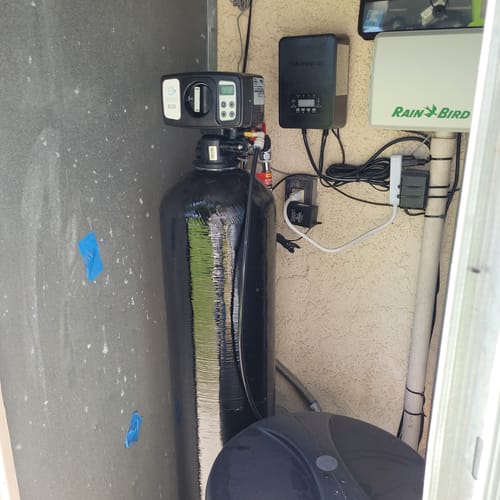
After months of dealing with iron-stained everything, I spent considerable time researching iron filtration systems. The water treatment industry offers several approaches: air injection oxidation, chemical oxidation with chlorine, manganese greensand filters, and catalytic carbon systems.
What made the Iron Master stand out from other iron filters?
The SoftPro Iron Master uses an air injection oxidation system combined with Katalox Light filtration media. This two-stage process first injects air into the water stream, oxidizing dissolved ferrous iron into ferric iron particles. The water then passes through the Katalox Light media, which catalyzes the oxidation process and filters out the iron particles.
Key factors that influenced my decision:
Katalox Light Technology: Unlike traditional greensand filters that require potassium permanganate regeneration, Katalox Light is a catalytic filtration media that regenerates with simple backwashing. This eliminates the need for chemical additives and reduces ongoing maintenance costs.
Air Injection System: The built-in air injection eliminates the need for a separate air compressor or venturi system. The unit automatically draws in air during the backwash cycle, maintaining the air pocket needed for oxidation.
High Iron Capacity: The system is rated to handle iron concentrations up to 30 ppm, far exceeding our 4.2 ppm levels. This provides confidence that the system won't be overwhelmed and should maintain consistent performance.
Certified Performance: The Iron Master carries WQA Gold Seal certification for iron reduction, providing third-party validation of its performance claims.
Compact Design: At 10 inches in diameter and 54 inches tall, the system fits in our utility room without requiring significant space modifications.
I also appreciated that SoftPro provides detailed sizing calculations based on iron levels, flow rate requirements, and household size. For our family of four with peak flow needs of 15 gallons per minute, they recommended the standard Click here for more info Iron Master model.
Unboxing and First Impressions
The Iron Master arrived via freight delivery in professional packaging that immediately conveyed quality. The main control valve, manufactured by Fleck, felt substantial and well-constructed. The fiberglass mineral tank had a smooth finish without any visible defects or inconsistencies.
Included components exceeded my expectations:
- Fleck 5600SXT digital control valve with clear LCD display10" x 54" fiberglass mineral tankKatalox Light filtration media (pre-loaded)Bypass valve assembly with unionsDrain line assembly with air gap fittingInstallation hardware including fittings and connectorsComprehensive installation manual with detailed diagrams
The control valve's digital display was intuitive, showing current time, gallons processed, and days until next regeneration. Build quality impressed me—the valve housing is constructed from reinforced thermoplastic with brass internals rated for continuous residential use.
One pleasant surprise was the inclusion of a bypass valve system. Many competitors charge extra for this essential component, but SoftPro includes it standard. The bypass allows water flow during maintenance and provides a way to isolate the system if needed.
The pre-loaded Katalox Light media was another time-saver. Rather than requiring media loading during installation, the tank arrived ready for connection. The media bed depth appeared proper, and the distributor tube was correctly positioned.
Installation Experience and Setup Process

Installing the Iron Master required basic plumbing skills and took me approximately six hours spread over a weekend. SoftPro offers professional installation, but I opted for DIY installation to save costs and gain familiarity with the system.
What preparation was needed before installation?
Pre-installation requirements included identifying the main water line location, ensuring adequate space for the system and future maintenance, and confirming electrical availability. The unit requires a standard 110V outlet for the control valve operation.
I installed the system in our utility room, positioning it after the pressure tank but before any other treatment equipment. The location needed to accommodate the 54-inch tank height plus additional clearance for valve service.
Installation Process Step-by-Step:
Water Line Preparation: I shut off power to the well pump and drained the pressure tank. Cutting into the main water line required careful measurement to ensure proper positioning of the bypass valve assembly.
Bypass Installation: The bypass valve installs using 1-inch NPT connections with union fittings that allow system removal without cutting pipes. Thread sealant and proper torque prevented any leaks during testing.
Tank Connection: Connecting the control valve to the mineral tank required threading the valve onto the tank's neck. The O-ring seal must be properly positioned to prevent bypass leakage.
Drain Line Installation: The backwash drain line connects to a floor drain or utility sink with an air gap fitting to prevent backflow contamination. I ran 1/2-inch tubing approximately 15 feet to our utility sink.
System Programming: The Fleck control valve requires programming for water hardness, iron levels, household size, and regeneration preferences. The manual provides clear instructions for entering these parameters.
Initial startup involved slowly opening valves and checking all connections for leaks. The system automatically initiated its first backwash cycle, which runs for approximately 30 minutes and uses about 100 gallons of water.
One challenge was achieving proper water pressure during the initial fill cycle. The air injection system requires adequate flow rate to function properly, so I temporarily removed downstream aerators to maximize flow during startup.
How the Katalox Light Technology Actually Works
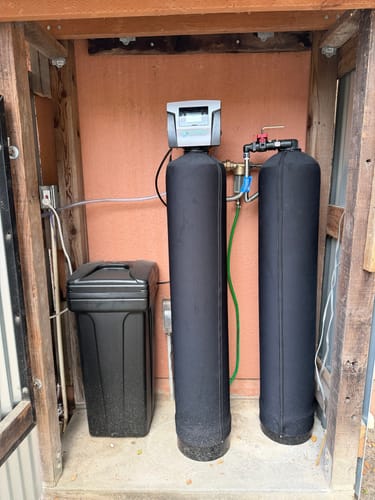
What exactly happens inside the Iron Master to remove iron?
The Iron Master employs a sophisticated two-stage process that addresses both dissolved and particulate iron contamination. Understanding this process helped me appreciate why the system performs so effectively.
Stage 1: Air Injection and Oxidation
The control valve maintains an air pocket in the top of the mineral tank through periodic air injection during backwash cycles. As water enters the tank, it mixes with this trapped air, introducing dissolved oxygen into the water stream.
This oxygen immediately begins oxidizing dissolved ferrous iron (Fe2 ) into ferric iron (Fe3 ), which forms visible particles that can be filtered. The reaction occurs rapidly—within seconds of air contact, clear water containing dissolved iron becomes cloudy with ferric iron particles.
Stage 2: Catalytic Filtration with Katalox Light
Katalox Light is a specialized filtration media made from manganese dioxide-coated pumice stone. Unlike traditional greensand, it functions as both a catalyst and a filter medium. The manganese dioxide coating accelerates the iron oxidation process while the porous structure physically traps iron particles.
As water flows down through the Katalox Light bed, several processes occur simultaneously:
- Continued oxidation of any remaining dissolved ironPhysical filtration of iron particles through the media bedAdsorption of iron particles onto the media surfaceCatalytic enhancement of the oxidation reaction
The media bed is approximately 3.5 feet deep, providing sufficient contact time for complete iron removal. Flow rates are controlled to ensure adequate residence time—typically 4-6 minutes for complete treatment.
Automatic Regeneration Process
Every three days (adjustable based on iron levels and water usage), the system automatically regenerates through backwashing. This process reverses water flow, lifting and expanding the media bed to release trapped iron particles. The backwash water, containing concentrated iron, flows to drain through the dedicated drain line.
During regeneration, the system also replenishes the air pocket essential for oxidation. Fresh air is drawn into the tank, ensuring consistent performance between regeneration cycles.
The entire regeneration cycle takes about 30 minutes and uses approximately 100-150 gallons of water, depending on iron levels and system size. This occurs automatically during programmed hours—I set mine for 2 AM to avoid disrupting daily water usage.
Real-World Performance and Water Quality Results
After eight months of operation, the Iron Master has consistently delivered exceptional results. I test our water monthly using both digital meters and test strips to monitor system performance and verify iron reduction.
Quantified Performance Results:
Iron Reduction: Pre-treatment iron levels measured 4.2 ppm using a Hach iron test kit. Post-treatment levels consistently test below 0.1 ppm—a 98% reduction that exceeds the EPA's aesthetic guideline of 0.3 ppm.
Water Clarity: Raw well water often appeared cloudy or had a slight yellow tint. Treated water is crystal clear with no visible discoloration or particles.
Taste and Odor: The metallic taste that plagued our water completely disappeared within 48 hours of system startup. The sulfur-like odor that was particularly noticeable in hot water is also eliminated.
pH Stability: Our water pH remained stable at 7.2-7.4 throughout treatment, indicating the system doesn't affect water chemistry beyond iron removal.
Flow Rate Maintenance: Despite adding filtration, our household water pressure and flow rates remained consistent. Peak flow during simultaneous shower and dishwasher operation showed no noticeable pressure reduction.
Daily Living Improvements:
The transformation in our daily life has been remarkable. Laundry no longer requires pre-treating for iron stains—white clothes stay white and colors remain vibrant. Our coffee maker, which previously required weekly descaling due to iron buildup, now operates cleanly for months between cleanings.
Bathroom cleaning time has decreased significantly. Orange stains no longer appear on fixtures, and toilet rings are minimal. Shower doors that previously required weekly scrubbing with iron stain removers now stay clear with routine cleaning.
Appliance Protection:
Our water heater efficiency has improved noticeably. Before treatment, iron sediment accumulated in the tank bottom, reducing heating efficiency and requiring annual flushing. The treated water has eliminated this sediment buildup, and our energy bills reflect the improved efficiency.
Dishwasher performance improved dramatically. Glassware that previously emerged spotted and cloudy now dries clear and spotless. The dishwasher's internal components no longer show iron staining, and rinse aid effectiveness has improved.
Operating Costs and Maintenance Reality
What does it actually cost to operate the Iron Master long-term?
Understanding the true operational costs was crucial for my purchase decision. After eight months of ownership, I can provide accurate, real-world expense data.
Electricity Consumption:
The Fleck control valve consumes minimal electricity—approximately 5-8 watts during operation and less than 1 watt in standby mode. Monthly electrical costs amount to less than $2 based on our local rate of $0.12 per kWh.
Water Usage for Regeneration:
Each backwash cycle consumes 125-150 gallons of water. With regeneration every three days, monthly water usage for system operation totals approximately 1,200-1,500 gallons. At our water cost of $3.50 per 1,000 gallons, this adds roughly $5 monthly to our utility bill.
Maintenance Requirements:
Unlike greensand systems requiring chemical regenerants, the Iron Master's operational costs are limited to water and electricity. No potassium permanganate, salt, or other chemicals are needed for normal operation.
Annual Maintenance Tasks:
- Control valve inspection and cleaning (DIY task taking 30 minutes)Drain line inspection for clogs or air gap issuesWater quality testing to verify continued performanceSystem sanitization if iron bacteria are present (optional)
Long-Term Component Replacement:
SoftPro estimates the Katalox Light media will last 8-12 years under normal conditions. Media replacement costs approximately $200-250 including shipping. The Fleck control valve carries a 5-year warranty with expected life exceeding 15 years.
Comparison to Previous Solutions:
Before the Iron Master, we spent roughly $40 monthly on bottled drinking water, iron stain removal products, extra laundry detergent, and frequent appliance maintenance. The system's $7 monthly operating cost represents an 82% reduction in iron-related expenses.
Annual Cost Analysis:
- Electricity: $24Water for regeneration: $60Maintenance supplies: $15Total annual operating cost: $99
This $99 annual cost compares favorably to the $480 we previously spent managing iron problems through temporary solutions and damage mitigation.
Honest Assessment: What Could Be Better
While the Iron Master has exceeded my expectations overall, eight months of ownership has revealed some limitations and areas for improvement. Honest assessment of these issues helps provide balanced perspective for potential buyers.
Regeneration Water Usage:
The system's water consumption during regeneration is significant—150 gallons every three days adds up over time. For households on limited well capacity or in drought-prone areas, this could be concerning. The regeneration schedule is adjustable, but extending intervals too much can compromise performance.
Initial Water Waste:
After regeneration cycles, the first 5-10 gallons of water show slight cloudiness as the system purges residual backwash water and re-establishes proper flow patterns. This means briefly running faucets to clear the lines, which some may consider wasteful.
Space Requirements:
The 54-inch tank height requires adequate ceiling clearance for valve service. Our utility room barely accommodated the system, and accessing the control valve for programming requires some maneuvering around other equipment.
Regeneration Noise:
During backwash cycles, the system produces noticeable water flow noise—not loud enough to wake us, but audible if you're nearby. The regeneration occurs at 2 AM by default, which minimizes disruption but might concern light sleepers in adjacent rooms.
Learning Curve:
Programming the Fleck control valve requires reading the manual carefully. While not complicated, the interface isn't immediately intuitive, and incorrect settings can affect performance. I initially programmed hardness levels incorrectly, which caused premature regeneration.
Iron Bacteria Limitation:
The system effectively removes dissolved and particulate iron but cannot address iron bacteria without additional treatment. Fortunately, our water doesn't have bacterial issues, but homes with severe iron bacteria problems might need supplemental disinfection.
Drain Requirements:
The 15-foot drain line run to our utility sink occasionally develops minor clogs from iron particles. Monthly flushing prevents problems, but it's an additional maintenance consideration not mentioned in initial documentation.
Despite these limitations, none significantly impact the system's overall value proposition. The iron removal performance and long-term cost savings far outweigh these minor inconveniences.